Category: Agility Classes

  • Is Agility Right for Your Dog?

    [fusion_builder_container type=”flex” hundred_percent=”no” equal_height_columns=”no” menu_anchor=”” hide_on_mobile=”small-visibility,medium-visibility,large-visibility” class=”” id=”” background_color=”” background_image=”” background_position=”center center” background_repeat=”no-repeat” fade=”no” background_parallax=”none” parallax_speed=”0.3″ video_mp4=”” video_webm=”” video_ogv=”” video_url=”” video_aspect_ratio=”16:9″ video_loop=”yes” video_mute=”yes” overlay_color=”” video_preview_image=”” border_color=”” border_style=”solid” padding_top=”” padding_bottom=”” padding_left=”” padding_right=””][fusion_builder_row][fusion_builder_column type=”1_1″ layout=”1_1″ background_position=”left top” background_color=”” border_color=”” border_style=”solid” border_position=”all” spacing=”yes” background_image=”” background_repeat=”no-repeat” padding_top=”” padding_right=”” padding_bottom=”” padding_left=”” margin_top=”0px” margin_bottom=”0px” class=”” id=”” animation_type=”” animation_speed=”0.3″ animation_direction=”left” hide_on_mobile=”small-visibility,medium-visibility,large-visibility” center_content=”no” last=”true” min_height=”” hover_type=”none” link=”” border_sizes_top=”” border_sizes_bottom=”” border_sizes_left=”” border_sizes_right=”” first=”true”][fusion_text]

    K9 Korral’s Mark Shambour was recently featured on moderndogmagazine.com!

    And the benefits of agility, agrees Mark Shambour, owner of K9 Korral Obedience Training Centre in Sarasota, Florida, are many.
    “The dogs just love it; most of them have what can only be described as huge grins on their faces the whole time they’re moving through a course,” he says. “Agility presents them with a challenge—how quickly and how well they can do the equipment—and the whole time they’re looking to you for instruction. From a pup’s perspective, what could be better?”

    Read more on moderndogmagazine.com here: http://moderndogmagazine.com/articles/agility-right-your-dog/69191

    [/fusion_text][/fusion_builder_column][/fusion_builder_row][/fusion_builder_container]
  • Dog Agility Training & Competition

    Dog Agility Training & Competition

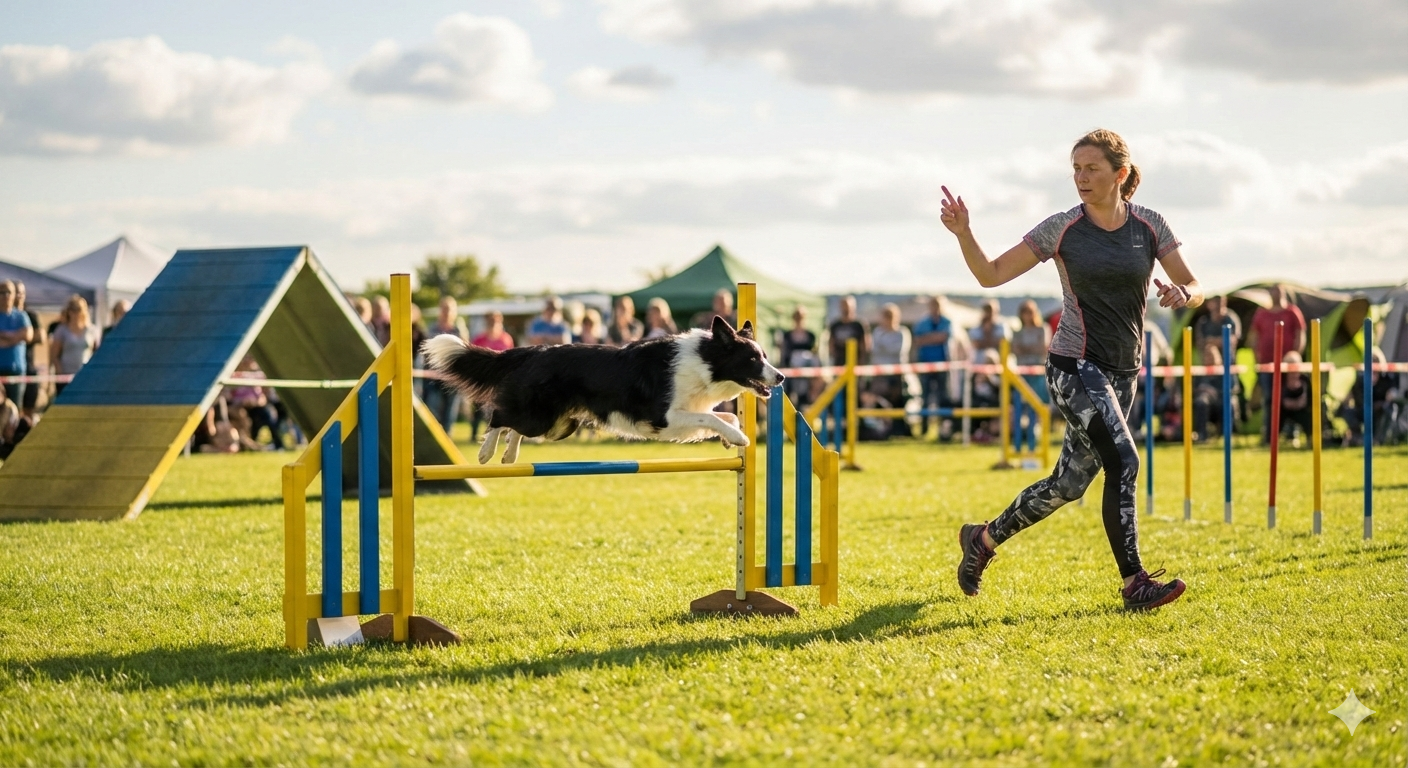
    A dog jumping over an obstacle as it's owner leads it through the agility course

    Getting ready for training

    If you have been seriously considering signing your dog up for agility training, then you should take the proper steps to prepare your k9 companion for what lies in store for them. Now what is dog agility you might ask? It’s a great sport that involves you and your dog, using teamwork towards a common goal. Not only is it quite entertaining to watch, it can be very addictive for the owner and dog alike, once both of you get the hang of it.

    Now lets go through how it all works. The Handler directs their dog through an obstacle course of a-frames, weave poles, dog walks, tunnels, jumps, teeter totters, and chutes, in a race for accuracy and over all time.

    You can’t however touch your dog or any of the obstacles that’s against the rules. There is also no use of a leash. You can only use visual and audible cues to direct your dog through the course.

    Next you should factor in some tips about how to prepare your dog. This will be physical, Show your dog what it will be engaging in throughout any of the serious training. Also, what it will experience later on if you wanted to go into competitions. Ultimately if your paying for training, your instructor will always know when your dog is ready for competition. So, don’t rush towards that too quickly. Ensure your dog is fully trained and is in peak condition.

    Getting Ready for Competition

    Obviously your dog needs to be fit, considerably attentive and don’t forget excited to give this their all. It’s also important that they’re jumping confidently to there full height. Unless of course you aren’t aiming for a specific size class for your dog to eventually compete in. Which means over sized obstacles, so the dogs can fit through and between them without knocking them down. Unless you are sure the competitions won’t included weaves. Then just be sure the dog is focused on your commands and excited to be there.

    Your dog will also be required to complete full sequences of obstacles pretty fluently. So, remember to be fair to your dog these competitions are a measure of there competence in the sport. Don’t force them to compete prematurely, make sure they’re well prepared for what’s expected of them.

    In Closing, it’s important to remember to have fun while doing this. If your not having fun, your dog will sense your tension. This can cause your dog to start acting up, and not following your directions correctly. Always remain calm, content, and over all remember to have fun.

  • Helpful Drills for Dog Agility Training

    Learning to handle your dog properly is a major role in dog agility training. This means communicating what you want your dog to do. Once your dog has the basics down, most errors that occur are due to the handler’s abilities. As a handler, you need to learn how to communicate what you want your dog to do or perform. One way to do that is to practice exercises that teach you how to better handle your dog.

    Every dog has his own way of running the course. Some dogs need little guidance while others need the handler by their side at all times. By watching your dog and how much he relies on you to complete the course, you’ll be able to determine how much handling your dog needs.

    To properly access the situation, try setting up two basic hurdles side by side and direct your dog to the right hurdle. Study your dog’s reaction as you send him to the hurdle. Does your dog leave your side or does your dog expect you to run or walk with him the entire way?

    Then try making the course into an “S” shape where you’ll be starting on the inside line and crossing over in the middle so that you will stay on the inside line. Try first with a fast obstacle such as a hurdle, tunnel or series of hurdles in the center of the course. Send your dog over the hurdles and cross behind your dog so that you switch effortlessly.

    Next, put a slow obstacle in the center of the course such as weave poles, a table or contact obstacle. Then continue with your dog until he gets to the downward edge of the contact obstacle. This will most likely be the second to last pole of the weaves. Cross in front of the dog and then continue him over to the next obstacle of the course.

    Try handling your dog first using the inside line and then moving onto the outside line to get a proper feel for handling either side of the course. If you have a very fast paced dog, then you will have to slow him down while you take the outer line. Likewise, if you have a slower paced dog, then you may have to slow down on the inside line, then work on speeding your dogs performance.

  • The Sport of Dog Agility

    The Sport of Dog Agility

    Dog Agility is an international sport. Direct your dog through an obstacle course in a race against the clock to measure accuracy and completion. Neither the dog nor obstacles can be touched by the handler. Consequently the handler’s controls are limited to voice, movement, and various body signals, requiring exceptional training of the animal and coordination of the handler.

    The History of the Sport:

    The sport’s roots can be traced back to the late 1970’s to a demonstration that was held at Crufts Dog Show in the United Kingdom. Dogs were required to run around a course designed similar to horse jumping courses during intermission as a way to entertain the audience. It has since spread rapidly around the world.

    What is an Agility Course?

    Agility courses consist of several standard obstacles laid out by a judge. All obstacles are staged by the judge in a specifically sized area. The surface may consist of grass, dirt, or a rubber like material. Depending on the type of competition, the obstacles may have a different order in which they must be completed.

    Expectations of the Dog Handler:

    In the beginning, courses can be a rather complicated task for your dog. For the dog to correctly complete a course without the direction and training of a handler, just aint gunna happen. In competitions, the dog handler must first observe the course, decide on the best strategies, and direct their dog. Precision and speed are equally important.

    What are the Basic Obstacles of a Course?

    An A-frame is 2 broad ramps hinged together and raised so that the hinged connection is above the ground, roughly forming an A shape.

    The Dog walk is 3 planks that connect at the ends. The center plank is raised to above the ground; so that the other 2 end planks form ramps that lead up and down.

    A Teeter-totter is a single plank that pivots on a fulcrum, much like the traditional seesaw. It is constructed off-balance so that the same end is always on the ground.

    The Crossover is a square platform, with ramps that descend from 3 or 4 of its sides. The dog must ascend and descend the correct ramp while changing direction.

    A Tunnel is a long vinyl tube, through which the dog runs. The tunnel is constructed of flexible vinyl and wire so that it can be set in a straight line or curvy.

  • The Different Competition Classes in Agility

    Competition Classes in Agility:

    Courses are designed by their own judges. They can also select from previously designed courses by using the rules of whom ever the funding organization. The course is laid out within a large area, with necessary distances between obstacles. Each class decides which dogs are worthy adversaries of achieving titles and how each task must be performed, but they all posses multiple similarities.

    What are some common classes?

    Junior courses are designed for the 18 and under crowd. These younger  dog handlers may compete with their k9’s at beginner, elementary, intermediate, and senior levels. Each section has more obstacles and generally gets harder the more you progress.

    Standard and Regular courses are both numbered. They consist of at least one of three primary obstacles include jumps, tunnels, and several weave poles. A more advanced dog course might consist of as many as 22 obstacles. A more minimal course might offer only about 15. The dog must properly navigate the obstacles. This must be achieved in the correct order within the standard course time.

    Jumpers or Jumping course is numbered. This consists primarily of various types of challenging jumps, weave poles, and tunnels. The dog must navigate the obstacles in the correct order within the standard time of the course. Most dogs will achieve their fastest speeds on this course because there are no contact obstacles in the way to slow them down.

    Gambles, Joker, and Jackpot courses are all unnumbered. In the opening period, the dog has only so much time in which to conquer appropriate tasks. The points awarded are based on the obstacles that have been completed. A whistle is blown when time runs out for the opening period. That’s when the gamble begins. There’s approximately 15 seconds to complete the tasks and obstacles.

    Power courses are not timed. This game features the contact equipment, weaves, table, a-frame, spread jump, and the long jump. If this section is navigated without receiving a penalty, the dog and handler are then allowed to advance to the Speed course, which consists of a timed jumping section.

    In the end, of any competition course, the dogs and their handlers that have competed have earned either a rosette or a bronze, silver, or gold medal. With many available sets of obstacles and plenty of room for error, there are many classes of competitions that can be played on the fields of agility.

  • Want to be Healthier in 2011? Adopt a Dog!

    The health benefits of owning a pet are well known – even watching a fish tank or stroking a cat can help lower blood pressure and create a sense of calm.  However, when it comes to the health benefits of having a pet, nothing is better than owning a dog!

    According to the well-respected resource WebMD, the health benefits of owning a dog include:

    1. Lower blood pressure
    2. Reduce stress
    3. Lower your risk for heart attacks
    4. Lower your risk for strokes
    5. Prevent and cure depression
    6. Help keep you physically fit
    7. Develop fewer allergies
    8. Strengthen your immunity to allergies
    9. Improve mental health
    10. Build stronger bones

    An overlooked way that owning a dog can help keep your wallet healthier is the savings in prescriptions and health care costs associated with illness.  Additionally, if you walk your dog twice daily, you’ll receive your daily recommended dose of cardiovascular activity.  To ramp up  that activity level, consider engaging in Florida dog obedience training, or even Florida Dog Agility Classes.  Both you and your pet will benefits from the physical activity involved in these training courses, and have fun while doing it!  Like any form of exercise, the key to keeping it up in having fun while doing it, and engaging in these types of activities with your pet are definitely enjoyable!

    Whether you are a senior citizen living alone, a stay-at-home-parent, or a young single person, your health and happiness can increase considerably by bringing a canine companion into your household.  Don’t delay…  it’s just what the doctor ordered!

  • New Year’s Eve Safety Tips for Pets

    Just like the 4th of July, New Year’s Eve is a fun holiday for people but a difficult one for our pets. Fireworks, which are common on New Year’s Eve, can cause even a dog who has been through k9 obedience training to run away from the scary, loud sounds and sparks. The fun and frivolity of a party can also be dangerous for your pet.

    A few common sense tips can help keep your dog safe on New Year’s while still allowing you to have your fun:

    1. Keep your dog inside on New Year’s Eve. Period. Even if your city doesn’t have scheduled fireworks, many individuals in your neighborhood may be setting them off, and some people even have the frightening and dangerous tradition of shooting firearms into the air at midnight. Keep your pets inside to help ensure their safety.
    2. Don’t take your pet with you on New Year’s Eve, even if you usually allow them to tag along. This will help ensure that a random frightening event won’t make them bolt away from you.
    3. Make sure your dog wears an identification tag. Even with your best efforts, if your dog gets out when friends are letting themselves in and out during a party, he may bolt. If your dog doesn’t have an id tag, write your phone number with a permanent marker on his collar.
    4. If you’re hosting a party, make sure that your guests keep alcohol and other dangerous foods away from your dog. Chocolate, raisins, and many varieties of nuts can be toxic to dogs, so keep your dog safely away from the temptation by crating them or locking them into a room where guests won’t be allowed.

    To help keep your dog safe on New Year’s Eve – and every day of the year, you should also strongly consider Florida dog obedience training.  There’s no substitute for a well-trained pet in a potentially dangerous situation.

  • Why Dogs Need Exercise

    Dogs have a built-in need to exercise.  It is a way for dogs to release energy.  If this need is unmet on a regular basis, then dogs find alternative ways to expend vigor that is not in a constructive manner.

    Lack of Exercise Equals Destruction

    Do you ever wonder why your dog chews up the house or why your pup scratches and digs all day long?  Does your dog engage in excessive barking?  Does your dog frequently raid the garbage?  You need to examine how often you play with your dog or provide your pup with exercise.  If your dog is lacking in participation of activities, then the dog will substitute the physical actions with negative behaviors.  These are bad habits for your dog to adapt.  To prevent this from happening enroll your pup in agility classes or dog obedience training classes.  These classes allow your pup the opportunity to socialize with other dogs, bond with you, and provide a positive atmosphere to let loose.  Thus, when you come home your dog is relaxed, happy and peaceful.

    Ample Exercise Exemplifies Happy Home

    When you ensure that your dog is engaging in exercise on a daily basis, you are improving the quality of life for your dog, and you.  You decrease your dog’s need to chew, bite and bark.  It eliminates a significant number of bad behaviors from continuing to develop.  The dog also will be able to sleep and rest quietly at night.  It also prolongs your dog’s life by keeping your dog in shape.

    For more information on why dogs need exercise talk to a Florida dog obedience training class today.

  • Prevent Your Dog from Chasing Runners

    It is hard to think about spring when the weather is still frigid outside, but it will happen before you know it.   And with warm weather, additional joggers and runners are noticeably active outside.  So how do you prevent your dog from running after these people when they go by?  There are different techniques you may utilize and here are just a few tips to help you and your dog.

    Bring Special Treats

    When you take your dog out for a walk, bring a stash of dog treats, small pieces of chicken, cheese or a hot dog with you.  You shall use this only when you see a runner pass by.  Let me explain.  When a runner goes by, you need something to distract your dog.  A regular dog treat may not be sufficient.  However, a tiny piece of chicken would be enough to keep your dog’s attention on you.  Furthermore, this will have the dog associate a runner going by as a positive thing.  For the dog sees runner, and thinks treat.  Thus, your dog will adapt to sitting or staying near you whenever someone jogs alongside.

    Encourage Safety

    The reason why it is vital to teach your dog not to run after people is for several reasons, but mainly for the runner and your dog’s safety.   If your dog chases after a person, then it may lead the dog into traffic and cause permanent injury to your dog and to the runner.  In addition, not everyone is comfortable with dogs.  Therefore, if a runner sees a dog chasing after him/her, then the runner may not respond in a friendly manner causing further aggression from both parties.

    Teach your dog not to chase after joggers.  Make sure you expend your dog’s energy by engaging your dog in daily exercise and agility classes.  Florida dog obedience training and dog agility classes will prevent your dog from chasing a person out of excitement or the need to release nervous energy.   By the time a runner passes by, and agility classes are over, your dog will be too tired to care if someone is coming the pup’s way or not.