Author: Mark S.

  • Safety Precautions – Inside and Outside the Home

    With all the everyday things that humans come into contact, such as certain foods and common household products. Many can be toxic to your dog or puppy so be sure to take necessary safety precautions.

    Garden and lawn hazards such as more then a few plants, given a nibble or two, can turn your dog’s day upside down. Most just cause an upset stomach, but some can be fatal.  Make sure that if you do choose to have these plants that they are out of the reach of your dog at all times.

    Play dough consists of just a few ingredients. Though, two of the three ingredients are perfectly harmless, the third worth mentioning is salt. Dogs may enjoy the play dough’s salty taste, just remember that if too much is consumed, it can cause salt toxicity, which unfortunately, there is no antidote for this reaction. So just be careful and stay observant the next time you catch your pup rummaging through your children’s things.

    Splintering bones such as from a chewed chicken bone can be very hazardous to your canine. Pieces of the bone can get stuck causing damage in the dog’s intestines and throat. When a dog is given any type of real bone including cow leg, supervision of course, is always recommended as pieces of the bone can break off. So just stay cautious and be sure to pick up and take away any small pieces so they are no chances they can be ingested. A safe bet is to purchase a
    bone specifically intended for a dog to chomp on.

    Antifreeze is perhaps the number one hazard to a dog. Less than one tablespoon of anti-freeze could be lethal to a dog 20 pounds and under. Your dog will smell the sweetness and may want to lick it up. This is dangerous for your dog if ingested, so when storing antifreeze, keep it far and well out of reach. Check under your car every now and then to make sure it is not on your drive way, just to be safe.

    Chocolate is another common household hazard for your dog. Although it may be one of your favorite thing to eat, it can be very dangerous for your dog. Chocolate contains caffeine which can make your dog very ill. This stimulant can raise the hearts rate, unfortunately to the point of being fatal. The effect it has depends both on the dogs size and the amount of chocolate that the dog has consumed.
  • The Sport of Dog Agility

    The Sport of Dog Agility

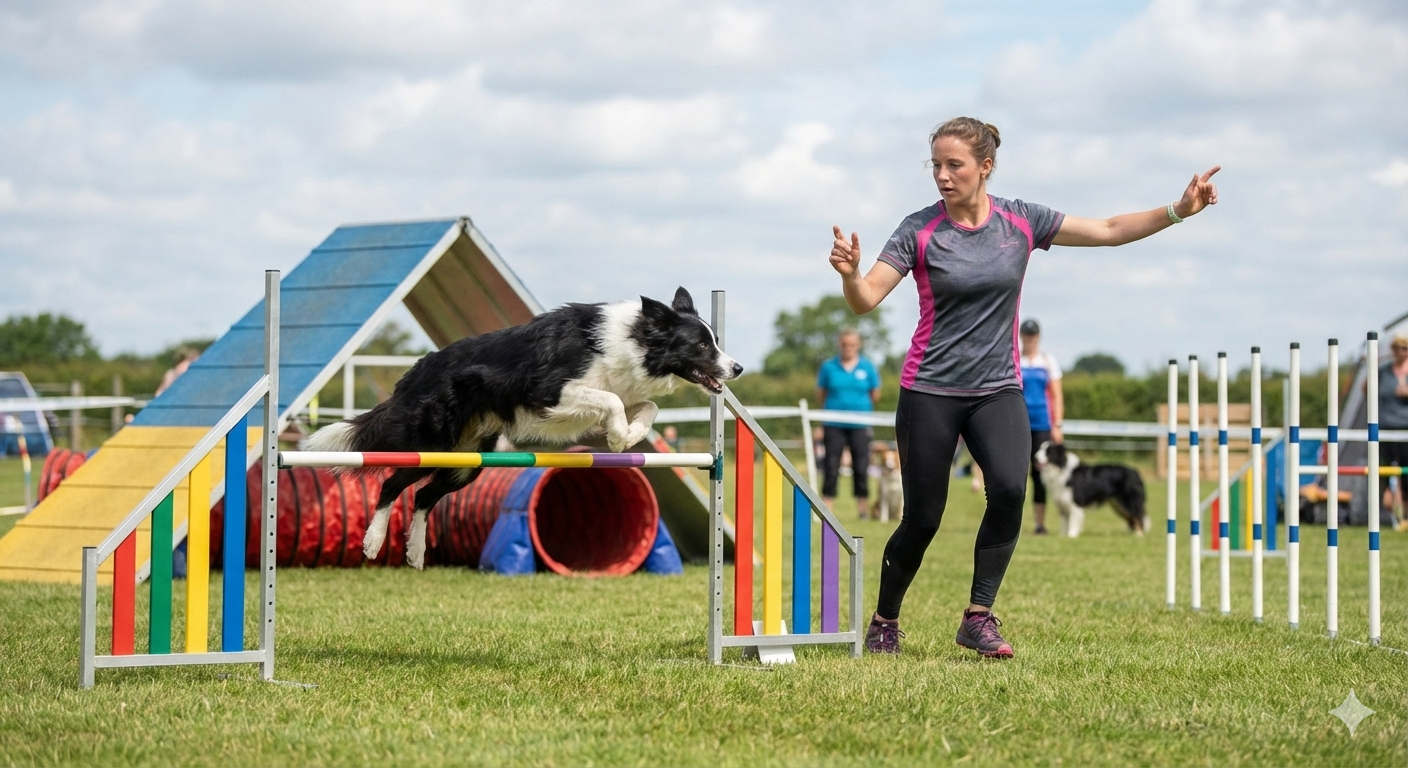
    Dog Agility is an international sport. Direct your dog through an obstacle course in a race against the clock to measure accuracy and completion. Neither the dog nor obstacles can be touched by the handler. Consequently the handler’s controls are limited to voice, movement, and various body signals, requiring exceptional training of the animal and coordination of the handler.

    The History of the Sport:

    The sport’s roots can be traced back to the late 1970’s to a demonstration that was held at Crufts Dog Show in the United Kingdom. Dogs were required to run around a course designed similar to horse jumping courses during intermission as a way to entertain the audience. It has since spread rapidly around the world.

    What is an Agility Course?

    Agility courses consist of several standard obstacles laid out by a judge. All obstacles are staged by the judge in a specifically sized area. The surface may consist of grass, dirt, or a rubber like material. Depending on the type of competition, the obstacles may have a different order in which they must be completed.

    Expectations of the Dog Handler:

    In the beginning, courses can be a rather complicated task for your dog. For the dog to correctly complete a course without the direction and training of a handler, just aint gunna happen. In competitions, the dog handler must first observe the course, decide on the best strategies, and direct their dog. Precision and speed are equally important.

    What are the Basic Obstacles of a Course?

    An A-frame is 2 broad ramps hinged together and raised so that the hinged connection is above the ground, roughly forming an A shape.

    The Dog walk is 3 planks that connect at the ends. The center plank is raised to above the ground; so that the other 2 end planks form ramps that lead up and down.

    A Teeter-totter is a single plank that pivots on a fulcrum, much like the traditional seesaw. It is constructed off-balance so that the same end is always on the ground.

    The Crossover is a square platform, with ramps that descend from 3 or 4 of its sides. The dog must ascend and descend the correct ramp while changing direction.

    A Tunnel is a long vinyl tube, through which the dog runs. The tunnel is constructed of flexible vinyl and wire so that it can be set in a straight line or curvy.

  • Private Education Lessons for Your Dog

    Are you afraid of a commitment to a six week class? Are your dog’s behavioral issues targeted to one specific area? Maybe you and your dog would just prefer a more intimate one-on-one training session? Look into private lessons for your canine friend. This is perfect if you always have a busy schedule. Realistic training goals personalized around your schedule.

    Advanced Education Lessons:

    An advanced education course will help to strengthen your dog’s maturity in everyday situations. After the completion of this intensive 6 week process, your dog will earn a Graduation Degree. Main issues covered such as, remaining calm while given affection, loose leash walking and how to heel, learning without giving in to distractions and specific games to build good reliability.

    Intermediate Education Lessons:

    An intermediate education course will help to develop your dog’s ability to further learn behaviors involving distance, duration and distractions. After making it through this extensive 6 week process, your dog will earn a certificate of completion. Key areas covered include, a brief review of basic commands such as to stay from a distance, heel, or stand. Learn how to focus despite any distractions, and games that will help to form your relationship.

    Beginner Education Lessons:

    Mostly intended for puppies but also welcomes adult dogs that have had no prior training. After this intensive 6 week process, your dog will earn a certificate of completion. Key topics covered such as simple cues, like sit, come, and to stay down. Learn problem solving and using respectable house manners. Take on health, grooming and proper dog nutrition as well as proper relationship building games.

    Personal Dog Training Camp:


    Make your dog’s day even more exciting by getting signed up today in a personal training camp. These sessions offer hands on training just for you and your canine friend. The pet training instructors arm themselves with positive reinforcing techniques to teach your dog some new skills, or to staying on top of a previous bad behavior.

    Private Puppy Education:

    Give your puppy the right start with classes that will encourage good behavior while helping you create that strong lasting bond with your pet. Specific areas including, introduction a simple command, such as sit, come here and stay there. Show basic manners and good social skills with other people and other dogs. Learn about relationship establishing games and problem prevention guidelines. Also, learn some tips about health, grooming and puppy nutritional facts.


  • The Different Competition Classes in Agility

    Competition Classes in Agility:

    Courses are designed by their own judges. They can also select from previously designed courses by using the rules of whom ever the funding organization. The course is laid out within a large area, with necessary distances between obstacles. Each class decides which dogs are worthy adversaries of achieving titles and how each task must be performed, but they all posses multiple similarities.

    What are some common classes?

    Junior courses are designed for the 18 and under crowd. These younger  dog handlers may compete with their k9’s at beginner, elementary, intermediate, and senior levels. Each section has more obstacles and generally gets harder the more you progress.

    Standard and Regular courses are both numbered. They consist of at least one of three primary obstacles include jumps, tunnels, and several weave poles. A more advanced dog course might consist of as many as 22 obstacles. A more minimal course might offer only about 15. The dog must properly navigate the obstacles. This must be achieved in the correct order within the standard course time.

    Jumpers or Jumping course is numbered. This consists primarily of various types of challenging jumps, weave poles, and tunnels. The dog must navigate the obstacles in the correct order within the standard time of the course. Most dogs will achieve their fastest speeds on this course because there are no contact obstacles in the way to slow them down.

    Gambles, Joker, and Jackpot courses are all unnumbered. In the opening period, the dog has only so much time in which to conquer appropriate tasks. The points awarded are based on the obstacles that have been completed. A whistle is blown when time runs out for the opening period. That’s when the gamble begins. There’s approximately 15 seconds to complete the tasks and obstacles.

    Power courses are not timed. This game features the contact equipment, weaves, table, a-frame, spread jump, and the long jump. If this section is navigated without receiving a penalty, the dog and handler are then allowed to advance to the Speed course, which consists of a timed jumping section.

    In the end, of any competition course, the dogs and their handlers that have competed have earned either a rosette or a bronze, silver, or gold medal. With many available sets of obstacles and plenty of room for error, there are many classes of competitions that can be played on the fields of agility.

  • Tips to Tricks For Your Pup (Part 2)

    Sometimes a dog will have trouble learning a new trick. For example, not all dogs can learn to fetch. Some dogs have more instinct (they are born with it) than others when it comes to carrying things in their mouths.

    Beg:

    Have your dog sit, facing you. Hold his favorite treat just above his head and tell him, “Say please.” Your dog will probably lift his front feet off the ground to reach the treat. As soon as the feet are lifted, even a little bit, give him the dog treat.

    Tip
    This is a hard trick for most dogs. Wait a little longer each time before giving the treat, but be careful not to let your dog fall over on his back. You are helping your dog develop his balance. Be kind and only do this a couple of times.

    Kiss:

    Here’s an easy one: Every time your dog licks your face, say, “Give me a kiss. Good boy! Give me a kiss.” If he isn’t a licker, put a little peanut butter on your cheek and say, “Give me a kiss.” When he licks it off say, “Give me a kiss,” again.

    Tip
    Tricks like this work because you put words with something your dog does. Pretty soon your dog hears “Give me a kiss,” and thinks about licking your face. Then you give him a hug, rub his ears and say, “Good boy!” Dogs love that.

    Roll Over:

    Start by having your dog lie down on his belly. You can stand over him or kneel beside him. Using a treat, hold it by his nose, and then move it around and behind him, so that he lies on his side and then rolls over. Tell him what a great dog he is!

    Tip
    After your dog has figured out what he has to do to get a treat, start throwing the ball two times in a row without giving him the treat. What you are trying to do is give him the treats less and less often so someday he won’t need the treats in the ball to fetch it.

    Say Hello:

    Start by sitting on a chair. While holding a treat, put your hand between your knees and encourage your dog to get it. As soon as your dog’s chin touches your leg, say “Say Hello!”. Then say “Release” or “OK” and give him the treat after he lifts his head.

    Tip
    Only give your dog the treat after you have released him. Increase the time his chin is touching your leg, so eventually your dog will keep it there while you pet him. Then release him and reward him. Your dog will soon charm your friends with this trick!

    Go Back:

    This is an easy one! Stand facing your dog and as you walk toward him, say “Go Back”. He will want to get out of the way and will automatically walk backwards!

    Tip
    If your dog doesn’t walk back in a straight line, practice up against a wall or in a narrow hallway. After your dog is walking backward with you, try walking toward him only a step or two. Eventually, you will be able to stand still and say “Go Back”.

    Take a Bow:

    When you see your dog take a big stretch, with his head down low, say, “Take a bow.” Every time he wakes up and stretches, say, “Take a bow.” Someday you will say, “Take a bow.” and your dog will take a big stretch, but it will look like he is bowing. As soon as he is finished, give him the treat.

    Tip
    Dog tricks like this work because you put words with something your dog does. It may take some dogs longer than others to figure this one out. Some dogs learn it in a week and some take years…yes, years! But one day you will say, “Take a bow,” and maybe, just maybe, your dog will take a bow.

    Lay Down:

    With your dog in a stand position, take a treat and hold it near the floor, under his nose. As your dog reaches down to get it (he may try to lie down), slip your hand under his belly to hold his rear end up. Hold him in that position and say, “Take a bow.” Keep the treat right by his nose, but don’t feed him. Stay there for just a second, release him, and then feed the treat.

    Tip:
    If you feed your dog the treat while he is in the bowing position, in the future he won’t bow until he sees the treat in your hand. If he learns that the treat comes later, he’ll be willing to perform for you without it right there all the time.

  • Tips to Tricks For Your Pup (Part 1)

    Tricks help your dog to learn. If your dog can learn tricks, then it can learn obedience and good manners. Go ahead…have some fun and teach your dog a new trick!

    The best way to teach your dog a trick, is to make it fun. Use praise and small treats to reward your dog.
    Practice new tricks only a few minutes at a time. You never want your dog to get bored when learning new things.

    Shake Hands
    Start by having your dog sit. Say, “Shake hands,” and take his paw with your hand. Hold his paw and say, “Good dog!” Let go of his paw. Do this a few times every day.
    TIP:
    After a while, say, “Shake hands,” but don’t take his paw. See if he raises his paw by himself. If not, keep showing him what to do by saying, “Shake hands,” and taking his paw with your hand. Your dog is not slow; he is just learning!

    Turn Around or Turn Left
    Start by having your dog stand up facing you. Let your dog see a treat in your hand. Stand still and say, “Turn around”. Lead the dog’s nose around to the left (clockwise) with the treat so he walks in a circle. When he comes back to where he’s facing you again, say, “Good dog!” and give him the treat.
    TIP:
    After some practice, hold the treat in front of you so your dog can see it and say, “Turn around,” but don’t lead his nose. See if he is ready to turn around by himself and get the treat. Pretty soon, he will turn around faster than you can say ‘Lassie!”
    If you choose to use the words, “Turn Left”, use them all the time. Don’t use “Turn around” sometimes, and “Turn Left” other times. Be consistent.

    Twirl or Turn Right
    “Twirl” is the same trick as “Turn Around” (see above), but this time your dog turns to the right (counterclockwise), instead of to the left.
    Start by having your dog stand up facing you. Stand still and say, “Twirl”. Lead the dog’s nose around to the right with the treat so he walks in a circle. When he comes back to where he’s facing you again, say, “Good dog!” and give him the treat.
    If you choose to use the words, “Turn Right”, use them all the time. Don’t use “Twirl” sometimes, and “Turn Right” other times. Be consistent.

    TIP:
    After your dog has learned “Turn Around” (or Turn Left) and “Twirl” (or Turn Right), you can put them together and have your dog look really smart. First have your dog “Turn Around” (turn to the left), and then say “Twirl” (turn to the right). Be careful, though, don’t get your dog dizzy!
    Be sure to teach Turn Around and Twirl separately. Wait until your dog has learned the first one very well.

    Crawl
    Start by having your dog lie down. Hold a treat just in front of his nose and say, “Crawl.” If he starts to stand up, say, “No, down…crawl.” Pull the treat away, keeping it low, near the ground and say, “Craaawl.” When your dog moves even an inch or two without standing up, praise him and say, “Good dog! Craaawl.”

    TIP:
    Your dog must know ‘Down’ ‘ before he can learn this trick.

    Speak
    Choose a game that your dog loves to play, like catch with a ball, or hide and seek with a toy. Then get him excited by saying, “Let’s play! Want to play?” and show him the ball or toy. Jump and act silly so he barks and then say, “Good dog, speak!” Then play the game as his reward for learning “Speak”.

    TIP:
    You can’t make a dog bark, but you can get him happy and excited so he wants to bark. After a while, your dog will bark when you say, “Speak.”
    Caution! If you have a dog that already causes trouble because of his barking, you might not want to encourage this behavior. If you decide it’s ok to teach it, be sure to teach “Quiet”, too.

    Take a Nap
    Have your dog lie down on his tummy. As you gently roll him over on his side, say, “Take a nap.” While he is lying on his side, keeping his head on the floor, say, “Take a nap.” Don’t give him a treat. Encourage him to stay there for a couple of seconds. Then say, “Ok” or “Wake up!”, let him stand up, and give him his reward.

    TIP:
    You can use the treat to lure your dog into a lying down position. Don’t give your a dog a reward while he is lying down. Give him a treat after he has completed the trick.

  • How to Teach Your Dog to Play Fetch?

    Fetch is a game we take for granted. Yet fetch is the most perfect of all dog games. It’s easy to learn. It’s easy to do. Fetch is great exercise for your dog (even exercise for you, if you walk or jog to a park to play). Most important, fetch is all about give and take (quite literally); you and your pup are working in tandem.

    You know the drill: You throw the ball, your dog brings it back. You throw the ball, your dog brings it back. You throw the ball… But what do you do when your dog seems completely unfamiliar with the game of fetch, when all those other dogs seem to know instinctively how to play?

    Although some breeds do have a natural instinct to play fetch—especially retrievers bred through the ages to fetch things, and herding dogs who have a sharp eye for objects wandering away from the flock—not every dog comes pre-programmed with this behavior. Why, some dogs seem to be thinking, would you throw something across the yard just so I have to run all the way over there and get it? And if I do, will you promise not to do that again?

    But playing fetch can be fun for you and training your dog. It’s also a great way for dogs to get their important daily dose of exercise.


    Assess your dog’s Fetch I.Q.

    Find a toy he really likes. Wave it in front of his face to get his interest. Toss it a few feet away and say, “Fetch!”  What does he do?


    If he runs to the toy, picks it up, and brings it back, congratulations. Your dog knows how to fetch. Go play!

    If your dog doesn’t seem to have any fetch instinct, the first step is to teach him that he’ll be rewarded for paying attention to the object you want him to fetch. (For this guide, we’ll say you’re teaching him with a ball. It may be another toy or a retrieving dummy.) Stock up on your dog’s favorite treats. Hold the ball out to your dog. If he sniffs it, praise him and give him a treat. Repeat this several times. Then, put the ball on the floor and say “Fetch.”  If your dog sniffs it or picks it up, praise him and give him a treat. Keep practicing until he understands that he has to sniff or pick up the ball to get the treat.

    Now it’s time to teach your dog to pick up the ball. Wave the ball around in the air to make it more enticing. As soon as he takes it in his mouth, praise him. If he won’t take the ball, try smearing it with a little peanut butter or meat paste. When he reliably takes the ball in his mouth.


    Now, you need to motivate your dog to give back the ball. Get your dog to take the ball. Praise him, then offer a treat. He’ll have to drop the ball to get the treat, so be sure you are there to take it. Praise him. Practice this a few times. When he reliably takes the toy then drops it for the treat.
    If your dog isn’t very interested in treats, you can also use two balls and entice him to drop one ball for the other.


    Now you are ready to try a small-scale fetch. Show your dog the ball. Toss the ball a few feet away from you and say “Fetch!” If he doesn’t go to the ball, try throwing it closer, or handing it to him again. When he does go to the ball, call him back to you, treat in hand, and trade treat for toy. Repeat, throwing the ball a little bit farther each time. Before you know it, you and your dog are playing fetch…just like all those other dogs!

    Every dog is different, motivated by different things and tempted by different variations of the game, but for many dogs, there will be a point during this dog training exercise when they suddenly understand what playing fetch is all about. At this point, the game is its own reward and you can save the treats for teaching your dog the rules for the next fun game.

  • Building Your Puppy’s Character

    What are the benefits?

    When you acquire a new puppy, what you do, or don’t do, can make a huge difference in the way the puppy turns out. Confident and happy adult dogs don’t just happen but are the product of good decisions and correct treatment from birth. When pups are young, they learn so much and what is learned has a lasting impact. Though the pup has a fairly short attention span, what things he learns are learned permanently and resistant to change. They learn to be submissive to your leadership and begin to learn what behaviors are acceptable.

    What to do?

    The puppy is dependent upon the correct environment and influences for its development. If the pup cries outside the bedroom for attention at night, whether in a crate or not, give it some attention, as you would a small child. Don’t ignore its cries. The pup is just upset from the separation of the door. You don’t have to pick it up or pet it, just let it know you are there for it and everything’s okay. The less attention you give a pup growing up the needier it becomes when mature the more attention you can give a pup as it is growing up, the more independent it will become.

    You must help the puppy to make the transition into the human environment. To become acceptable companions, they need to interact with you, your family, and other people and dogs. Try to expose your puppy to a variety of new environments and situations.

    Deny benefits such as a treat as a consequence for any deliberate misbehavior. What he does now is what he will likely do later. So, don’t allow your puppy to do things which will be unacceptable when he becomes a dog.

    What not to do?

    Physical punishment teaches a dog nothing, except how to avoid the punishment. It is far more effective, to teach the pup what to do rather than punish it for something it has done. Yelling and making constant threats about it is not an effective way of going about an issue.

    Some dog owners believe that puppies outgrow their problems. The truth is, they actually grow into them. Little problems grow up to be big bad habits if they are not addressed. And then of course, the problems are much more difficult to resolve.

  • How to introduce your dog to a new cat

    What’s this rivalry all about?

    Dogs that haven’t been raised with cats usually see them not as friends, but as prey. Cats that are unfamiliar with dogs are usually afraid and intimidated by them. They are two different animals with two different distinctive personalities. Be aware that nature designed canines to be predators.

    How do you make a proper introduction?

    Feed both your dog and the cat before the introduction. They’ll be less territorial on a full stomach. Keep a firm grip on your dog’s leash, which will provide him with a sense of security and im sure will make the cat feel much better about the situation. If your dog seems aggressive, immediately remove the cat and try again later. You don’t want to force the situation by pushing them together before your dog is ready. Small treats increase your dog’s motivation to perform, which will be necessary in the presence of such a strong distraction as a new cat. Take a few minutes every day to give your dog this carefully supervised attention.

    Will it be safe to leave them alone together?

    Some dogs learn quicker than others. It may take your dog weeks maybe even months to become trustworthy around cats. Until you’re sure the dog will remember his training, never leave them alone together until you are certain that they are comfortable with each other. If you walk away while they are still investigating each other, you may regret what you find when you return.

    What if the cat is the instigator?

    Cats will generally rotate their schedules to accommodate the presence of a dog. If the cat teases your dog as the dog goes by, allow your dog to chase the cat around a bit. Learning is most definitely a two-way street. The cat needs to learn not to provoke the dog, just as the dog needs to learn not to provoke the cat. It may be necessary to give separate attention to each of them.


    The Bottom Line:


    Make your life less stressful and plan carefully when looking for a new cat to get along with your dog. Your best shot at them coexisting is to get your dog and cat when they’re both young. When they grow up together from the get go, they are much more likely to get along, and they may even become close pals.

  • Could Your Puppy Become A Service Dog?

    Who can benefit from a service dog?

    The ADA defines a service animal as any signal dog, guide dog, or any other animal trained to provide assistance to an individual with a disability. Remember, a Service dog is not a pet. If you are not disabled, then your pet cannot become a service dog unless you donate it for training as a service dog for someone who is disabled.

    What are service dogs?

    Service animals are highly skilled to perform some of the functions and tasks that an individual with a disability could not. But there are service animals that assist those with other disabilities in their everyday activities.

    What makes a service dog special?

    Obstacle Avoidance is when an obstacle is recognized, the dog is instructed to navigate around that obstacle. It must do so regardless of whether the best path lies to the left or right of the obstacle, and while not only sensing the dogs own path, but the path of his disabled partner as well.

    Intelligent Disobedience is recognizing when there is an exception to a command and disobeying out of duty rather than disobeying because the dog is distracted. For example, if a guide dog is given a command to “forward” into a street, but it sees a car coming, the dog will intelligently disobey the command because it understands its dangerous to the handler to step into traffic.

    What are the costs and requirements?

    Demand for the service dog continues to rise, which means so does the expense of training them. The average cost in professionally training just one of these animals is roughly $15,000 -$20,000 between medical costs, training, boarding and fees for licensing.

    It’s not as easy to train your own dog to become a Service dog as you might think. If you have never trained a dog before, please look into a dog trained in a program, assistance of a dog trainer to help you, or in a facility that has given you permission. If you are training a puppy, you must wait for it to finish growing before teaching it certain tasks.

    A Public Access Test will evaluate your dog on performance of tasks and obedience commands, despite distractions commonly found in public accommodations. A dog becomes a full service dog when it meets the requirements of a full service dog. Since that would be is the last phase of training, passing all the tests is an indicator the dog is ready to work.

    Good Luck!