Category: Dog Training Classes

Posts that include all of our training classes. From private lessons to Canine Good Citizen, all of our training classes fall into this category.

  • Why Oh’ Why Does My Dog Eat Poop?!

    Do you have a puppy or older dog that has taken a fancy to eating their feces? This filthy habit, also known as “Dog Coprophagia” is one dog problem, we as owners… HATE! This is generally more common in puppies up to a year old, but can occur at any stage throughout your dog’s life.

    There is good news for us dog lovers though. Several proven techniques and training methods can be called upon for correcting this before it can become a permanent habit.

    *NOTE* If your dog has this problem (Coprophagia), ensure that all dog vaccinations and worming treatments are current or up to date. The reason for this is that various diseases and internal parasites can be passed from dog to dog due to the eating of their feces.

    Possible Causes:

    Sadly, in most cases, your dog just thinks poop tastes fantastic. Just the thought of this alone is absolutely disgusting and I’m sure most would agree.

    Your dog may have a mineral or vitamin deficiency and they will eat their feces in an effort to help compensate and restore this balance.

    It may be a sign or symptom of anxiety, stress or your dog is just suffering from plain old boredom. Certain medications or antibiotics for your dog have even been known to cause this habit to form.

    This can be the result from over-feeding your dog. This will not allow for the proper digestion of food, which means his feces will still smell and taste the same as when it was consumed. With this being said, its also a possibility due to feeding your dog too little, such as once a day, some dogs become very hungry and will scavenge around for any kind of food.

    Possible Solutions:

    Feed your dog twice a day as appose to only once.  Try to get your dog interested in a nutritious and well balanced meal.

    If you catch your dog in the act red handed, try to provide him with a distraction. Call him over to you right away with a reward in hand to praise him with. This should be sufficient enough to break this habit, but you must stay consistent when doing this.

    You must enforce your strategy every time and stick with it. The longer you let your dog do this, the harder it will be to break the habit.
  • General Guidelines for Effective Dog Training

    No matter what type of dog training you prefer, it is important to know the general rules and policies for dog training. Knowing these rules does not just entail effective training but also make the process a whole lot easier. Below are some useful examples that every dog trainer should learn to follow for effective dog training.

    -Make sure that every dog training session is short and fun. Animal behavior experts say that short periods of training is always better than long periods of time.

    -Reward your dog. Give him treats or chew bones every time they follow your orders and commands.

    -Try not to punish dogs by shouting or yelling at them if they don’t follow what you want them to do. Doing so will only make them aggressive.

    -Be consistent. Remember that your dog will never learn the things that you teach them right away. Consistency is the key here. Do the same thing again and again until they’ve learned your orders and commands by heart.

    -Teach him tricks and commands one at a time and make sure to start from the simplest one before moving on to more complicated ones. Teach them a new trick or command only if they’ve mastered the previous one.

    -Learn what motivates your dogs to behave and be obedient. It can be in the form of dog food, treats, or toys.

    -Never hit dogs every time they do something wrong or unwanted. Ignoring them is the best way to let them know they will never get anything if they keep on doing whatever it is that they’re doing.

    -Test their obedience in various situations. This is the best way to ensure they still follow your commands and orders even when they are outside and around people.

    Whatever dog training method that you may go with, it is critical that you make them feel you are the leader in your dog-owner pack. It is also important that you make them understand what are good and acceptable behaviors and what are not. Training your dog to become a good and well-behaved citizen may not be easy, but all your time, efforts and patience will certainly pay off. Remember that there’s nothing better than a dog that knows not just how to protect their owners but also follows orders and commands and knows how to behave in different surroundings and situations.

  • Effective Training Techniques for Dogs of all Shapes and Sizes

    The term obedience training is generally used for the various methods of helping your dog to behave in a more expectable manner. There are many different methods in dog training techniques such as positive reinforcement, reward training, collar and leash, marker training, dog whispering, and clicker training.

    Accomplish the following with the right dog training:

    Your dog wasn’t born programmed to meet your behavioral standards.  So don’t expect your dog to know everything right away!The key to training your dog to respond to verbal commands is repetition and consistency. He is looking to you as a guide to lay a good foundation for behavior.

    The best corrective measures are rewards and praise. Unlike children, dogs don’t have the mental capacity to fully understand the consequences of their actions. Time outs and repeating “NO” may not be as effective as you would like. Instead, praise your dog when he has done what you have asked of him or her, and offer an appropriate reward. When your dog doesn’t follow commands, provide appropriate correction. Balance is a strong key when doing this.

    Don’t punish for unacceptable behaviors your dog has committed when he has no way to know any better. Punishing your dog for a behavior that you have not spent time on or he has not been properly trained to do, if you ask me, this is unfair to your dog.

    Make obedience training sharp and short for the both of you to enjoy. So take things slow. Having your dog to follow commands and respond the way you expect doesn’t happen overnight. It takes time. It’s easier for your dog to master one command at a time then move to the next one, and build on the foundation you all have established. Stimulate and challenge your dog throughout the obedience training process.


    The Benefits:

    Effective dog training is the best possible thing you can do for you and your dog. This will allow for a very rewarding relationship. With the right kind of obedience training can make your dog an absolute joy to be around. When well trained, he is more trustworthy, and you as the owner can feel confident in your dog and his abilities as you extend more and more freedoms to your canine friend. Trust, respect, and boundaries are all keys for unlocking a healthy owner-dog relationship.

  • Dog Pregnancy Care Tips

    A pregnant dogs body is going through many changes as the puppies are growing inside her therefore her needs are going to increase. They need special care to ensure they are in tip top shape before the big day. A dog’s pregnancy generally last from 60 to 63 days.


    The symptoms and signs of a pregnant dog:


    Three weeks after mating, the female dog may have an upset stomach and not want to eat for about a week to 10 days. One way to tell if your dog is pregnant is to check her vulva. The swelling would not have gone down after her heat and looks enlarged. Thirty days after being bred a blood test can be done by a veterinarian to confirm pregnancy. At 21 days an ultrasound can be done to confirm pregnancy and at 45 days radiographs can be taken for an accurate count of puppies inside.

    During the first 30 days of pregnancy she can eat her normal diet, only as long as it is a high quality dog food. This food has plenty of nutrients. During the last month of pregnancy start switching her over to a high quality puppy food, make the diet change over a week’s time. Also, be aware that there are some vitamin supplements that can cause birth defects so check with your veterinarian before choosing the wrong one. Do not give her any vitamin supplements.

    Try to take her on several daily walks for a good source of exercise. It is important that she does not become overweight during this time and the walks will keep her in shape for delivery. Letting the dog run in the backyard is not equal to a walk, a walk is mental and physical exercise. During the last 3 weeks of gestation do not take her out and do not expose her to other dogs as added protection against disease.

    Never give a pregnant dog any kind of vaccination. Some vaccines can cause still births. Vaccinations should be given prior to breeding so that the protection can be passed to the puppies by the mother’s milk.

    One week prior to birth, start taking the mothers body temperature. A normal bodily temperature for a dog is about 100.5 – 102.5. About 24 hours before giving birth, her temperature will drop a few degrees. This will give you time for necessary preparations.

  • The Clicker Training Method

    Operant conditioning is a scientific description of the way animals learn from the consequences of certain behaviors. In dog training, positive reinforcement is a type of operant conditioning that is commonly used. A system based on sound equals rewards, allows your dog to learn difficult skills, without the use of force or punishment. Your dog will learn to quickly identify what behaviors are desired and which are deemed unacceptable.

    The clicker is typically a small plastic box with a metal strip inside that makes a distinct clicking sound when you press it. To teach a dog the meaning of the click, a treat is given immediately after clicking, resulting in the dog learning the positive effects of the sound. The click is more distinct than verbally praised commands and is much more effective than only giving your dog treats.

    Where did this method originate from?

    At sometime in the recent past, behavioral researchers including Norm Guttman, Marian Kruse and Keller Breland, in a laboratory, were among the first to understand the clicker method. They had realized that rats always stop what they are doing whenever they heard their food dispenser make a sound, which indicates its time to eat. Under the instruction of B.F. Skinner, they decided to try using a sound to correct behavior outside the lab, such as in dogs.

    How to conquer the clicker:

    To get things started, begin teaching your dog basic commands in a quiet area. Make sure to have ready a sufficient amount of your dog’s favorite treats. The treat should be small enough to be consumed instantly. Press the clicker and immediately give your dog a treat. Repeat 5-10 times. You can test your success by clicking when your dog is not paying attention to you. If your dog instantly responds to the click by looking in your direction, then expecting a treat, you’re starting to get somewhere.

    At the exact moment your dog performs the desired action, press the clicker. Follow with a treat and praise. One of the best things about the clicker is the accuracy. The dog associates his action with the click and, subsequently, the reward. Not only does your dog better understand what he is doing, this also makes him more likely to repeat the action when asked in the future. This allows the training process to be totally hands-off, aside from treat giving.

  • Teach Your Dog How to Skateboard!

    Here’s a fun one!

    Generally, when imagining a skateboarding dog, you might be thinking of a movie or commercial. So, what would it take to make this a reality for you and your dog, you ask yourself? To teach your dog a head turning trick like this will require patience, a handful of treats, determination, and a dog who listens well. So get your dog, grab a skateboard and get outside. Don’t be surprised to get some attention from this, who knows, you may even draw a crowd.

    For Starters:

    Try to get your dog to show some interest in the skateboard. Let him investigate by sniffing it and climbing on it. Try encouraging him to sit and stand on the board by giving him a treat. Try not to force your dog on to the skateboard. Work at it and he will begin to associate this with fun. Shaping your dog to do this can be complicated because the skill of riding a skateboard won’t just come naturally.

    First, decide exactly what you want your dog to do. Do you want him to mount the board and just ride along or do you want him to use his foot to move? Give your dog an idea of what he’s up against by letting him watch as you ride around. Keep an eye out, he might be chasing after you.

    How to Get Things Rolling:

    Aim to avoid doing this in the streets. Use sidewalks if possible, just as a safety precaution. Set the skateboard in front of your dog. Place one paw on the board. Offer him a treat if he cooperates. Place second paw on the board until the dog is completely on. If he stays, then reward him with another treat.

    Although, getting your dog to stay on the skateboard is a feat of its own, getting him to feel comfortable while moving, may become quite the task. On your first few attempts, try to keep a slow and steady pace. Then push the dog as far as he we will allow.

    Try not to do more than 4 attempts a day. More than that can result in you and your dog getting burnt out. This can be a positive and fun experience for you and your dog. The both of you may get frustrated at times along the way. When this happens, just take a deep breath and come back to try again later on.

    Happy Thanksgiving Everyone!

  • The Sport of Dog Agility

    The Sport of Dog Agility

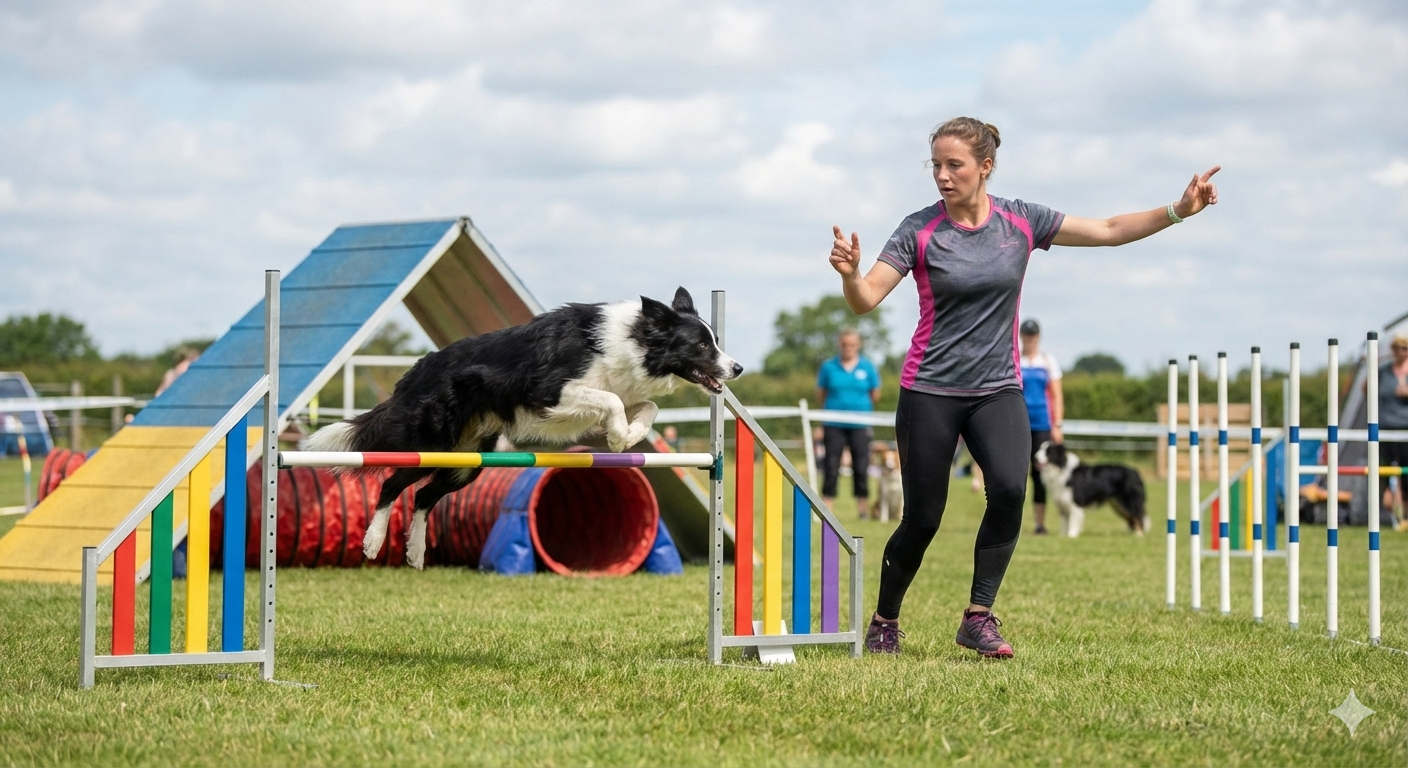
    Dog Agility is an international sport. Direct your dog through an obstacle course in a race against the clock to measure accuracy and completion. Neither the dog nor obstacles can be touched by the handler. Consequently the handler’s controls are limited to voice, movement, and various body signals, requiring exceptional training of the animal and coordination of the handler.

    The History of the Sport:

    The sport’s roots can be traced back to the late 1970’s to a demonstration that was held at Crufts Dog Show in the United Kingdom. Dogs were required to run around a course designed similar to horse jumping courses during intermission as a way to entertain the audience. It has since spread rapidly around the world.

    What is an Agility Course?

    Agility courses consist of several standard obstacles laid out by a judge. All obstacles are staged by the judge in a specifically sized area. The surface may consist of grass, dirt, or a rubber like material. Depending on the type of competition, the obstacles may have a different order in which they must be completed.

    Expectations of the Dog Handler:

    In the beginning, courses can be a rather complicated task for your dog. For the dog to correctly complete a course without the direction and training of a handler, just aint gunna happen. In competitions, the dog handler must first observe the course, decide on the best strategies, and direct their dog. Precision and speed are equally important.

    What are the Basic Obstacles of a Course?

    An A-frame is 2 broad ramps hinged together and raised so that the hinged connection is above the ground, roughly forming an A shape.

    The Dog walk is 3 planks that connect at the ends. The center plank is raised to above the ground; so that the other 2 end planks form ramps that lead up and down.

    A Teeter-totter is a single plank that pivots on a fulcrum, much like the traditional seesaw. It is constructed off-balance so that the same end is always on the ground.

    The Crossover is a square platform, with ramps that descend from 3 or 4 of its sides. The dog must ascend and descend the correct ramp while changing direction.

    A Tunnel is a long vinyl tube, through which the dog runs. The tunnel is constructed of flexible vinyl and wire so that it can be set in a straight line or curvy.

  • Private Education Lessons for Your Dog

    Are you afraid of a commitment to a six week class? Are your dog’s behavioral issues targeted to one specific area? Maybe you and your dog would just prefer a more intimate one-on-one training session? Look into private lessons for your canine friend. This is perfect if you always have a busy schedule. Realistic training goals personalized around your schedule.

    Advanced Education Lessons:

    An advanced education course will help to strengthen your dog’s maturity in everyday situations. After the completion of this intensive 6 week process, your dog will earn a Graduation Degree. Main issues covered such as, remaining calm while given affection, loose leash walking and how to heel, learning without giving in to distractions and specific games to build good reliability.

    Intermediate Education Lessons:

    An intermediate education course will help to develop your dog’s ability to further learn behaviors involving distance, duration and distractions. After making it through this extensive 6 week process, your dog will earn a certificate of completion. Key areas covered include, a brief review of basic commands such as to stay from a distance, heel, or stand. Learn how to focus despite any distractions, and games that will help to form your relationship.

    Beginner Education Lessons:

    Mostly intended for puppies but also welcomes adult dogs that have had no prior training. After this intensive 6 week process, your dog will earn a certificate of completion. Key topics covered such as simple cues, like sit, come, and to stay down. Learn problem solving and using respectable house manners. Take on health, grooming and proper dog nutrition as well as proper relationship building games.

    Personal Dog Training Camp:


    Make your dog’s day even more exciting by getting signed up today in a personal training camp. These sessions offer hands on training just for you and your canine friend. The pet training instructors arm themselves with positive reinforcing techniques to teach your dog some new skills, or to staying on top of a previous bad behavior.

    Private Puppy Education:

    Give your puppy the right start with classes that will encourage good behavior while helping you create that strong lasting bond with your pet. Specific areas including, introduction a simple command, such as sit, come here and stay there. Show basic manners and good social skills with other people and other dogs. Learn about relationship establishing games and problem prevention guidelines. Also, learn some tips about health, grooming and puppy nutritional facts.


  • The Different Competition Classes in Agility

    Competition Classes in Agility:

    Courses are designed by their own judges. They can also select from previously designed courses by using the rules of whom ever the funding organization. The course is laid out within a large area, with necessary distances between obstacles. Each class decides which dogs are worthy adversaries of achieving titles and how each task must be performed, but they all posses multiple similarities.

    What are some common classes?

    Junior courses are designed for the 18 and under crowd. These younger  dog handlers may compete with their k9’s at beginner, elementary, intermediate, and senior levels. Each section has more obstacles and generally gets harder the more you progress.

    Standard and Regular courses are both numbered. They consist of at least one of three primary obstacles include jumps, tunnels, and several weave poles. A more advanced dog course might consist of as many as 22 obstacles. A more minimal course might offer only about 15. The dog must properly navigate the obstacles. This must be achieved in the correct order within the standard course time.

    Jumpers or Jumping course is numbered. This consists primarily of various types of challenging jumps, weave poles, and tunnels. The dog must navigate the obstacles in the correct order within the standard time of the course. Most dogs will achieve their fastest speeds on this course because there are no contact obstacles in the way to slow them down.

    Gambles, Joker, and Jackpot courses are all unnumbered. In the opening period, the dog has only so much time in which to conquer appropriate tasks. The points awarded are based on the obstacles that have been completed. A whistle is blown when time runs out for the opening period. That’s when the gamble begins. There’s approximately 15 seconds to complete the tasks and obstacles.

    Power courses are not timed. This game features the contact equipment, weaves, table, a-frame, spread jump, and the long jump. If this section is navigated without receiving a penalty, the dog and handler are then allowed to advance to the Speed course, which consists of a timed jumping section.

    In the end, of any competition course, the dogs and their handlers that have competed have earned either a rosette or a bronze, silver, or gold medal. With many available sets of obstacles and plenty of room for error, there are many classes of competitions that can be played on the fields of agility.

  • Could Your Puppy Become A Service Dog?

    Who can benefit from a service dog?

    The ADA defines a service animal as any signal dog, guide dog, or any other animal trained to provide assistance to an individual with a disability. Remember, a Service dog is not a pet. If you are not disabled, then your pet cannot become a service dog unless you donate it for training as a service dog for someone who is disabled.

    What are service dogs?

    Service animals are highly skilled to perform some of the functions and tasks that an individual with a disability could not. But there are service animals that assist those with other disabilities in their everyday activities.

    What makes a service dog special?

    Obstacle Avoidance is when an obstacle is recognized, the dog is instructed to navigate around that obstacle. It must do so regardless of whether the best path lies to the left or right of the obstacle, and while not only sensing the dogs own path, but the path of his disabled partner as well.

    Intelligent Disobedience is recognizing when there is an exception to a command and disobeying out of duty rather than disobeying because the dog is distracted. For example, if a guide dog is given a command to “forward” into a street, but it sees a car coming, the dog will intelligently disobey the command because it understands its dangerous to the handler to step into traffic.

    What are the costs and requirements?

    Demand for the service dog continues to rise, which means so does the expense of training them. The average cost in professionally training just one of these animals is roughly $15,000 -$20,000 between medical costs, training, boarding and fees for licensing.

    It’s not as easy to train your own dog to become a Service dog as you might think. If you have never trained a dog before, please look into a dog trained in a program, assistance of a dog trainer to help you, or in a facility that has given you permission. If you are training a puppy, you must wait for it to finish growing before teaching it certain tasks.

    A Public Access Test will evaluate your dog on performance of tasks and obedience commands, despite distractions commonly found in public accommodations. A dog becomes a full service dog when it meets the requirements of a full service dog. Since that would be is the last phase of training, passing all the tests is an indicator the dog is ready to work.

    Good Luck!